Стаття
Наукова стаття
Influence of Geological Conditions and External Factors on the Structure and Decor of the Rock-Cut Monasteries of China
ID елемента: 83089
1 Медіафайлів
2026/11/17
Цитування
eNUPPIR (). Influence of Geological Conditions and External Factors on the Structure and Decor of the Rock-Cut Monasteries of China. https://reposit.nupp.edu.ua/item/83089
eNUPPIR. "Influence of Geological Conditions and External Factors on the Structure and Decor of the Rock-Cut Monasteries of China." Web. . <https://reposit.nupp.edu.ua/item/83089>.
eNUPPIR. "Influence of Geological Conditions and External Factors on the Structure and Decor of the Rock-Cut Monasteries of China." Accessed . https://reposit.nupp.edu.ua/item/83089.
Скопійовано в буфер обміну
Стаття
Властивості
Тип
Українська
Англійська
Назва
Англійська
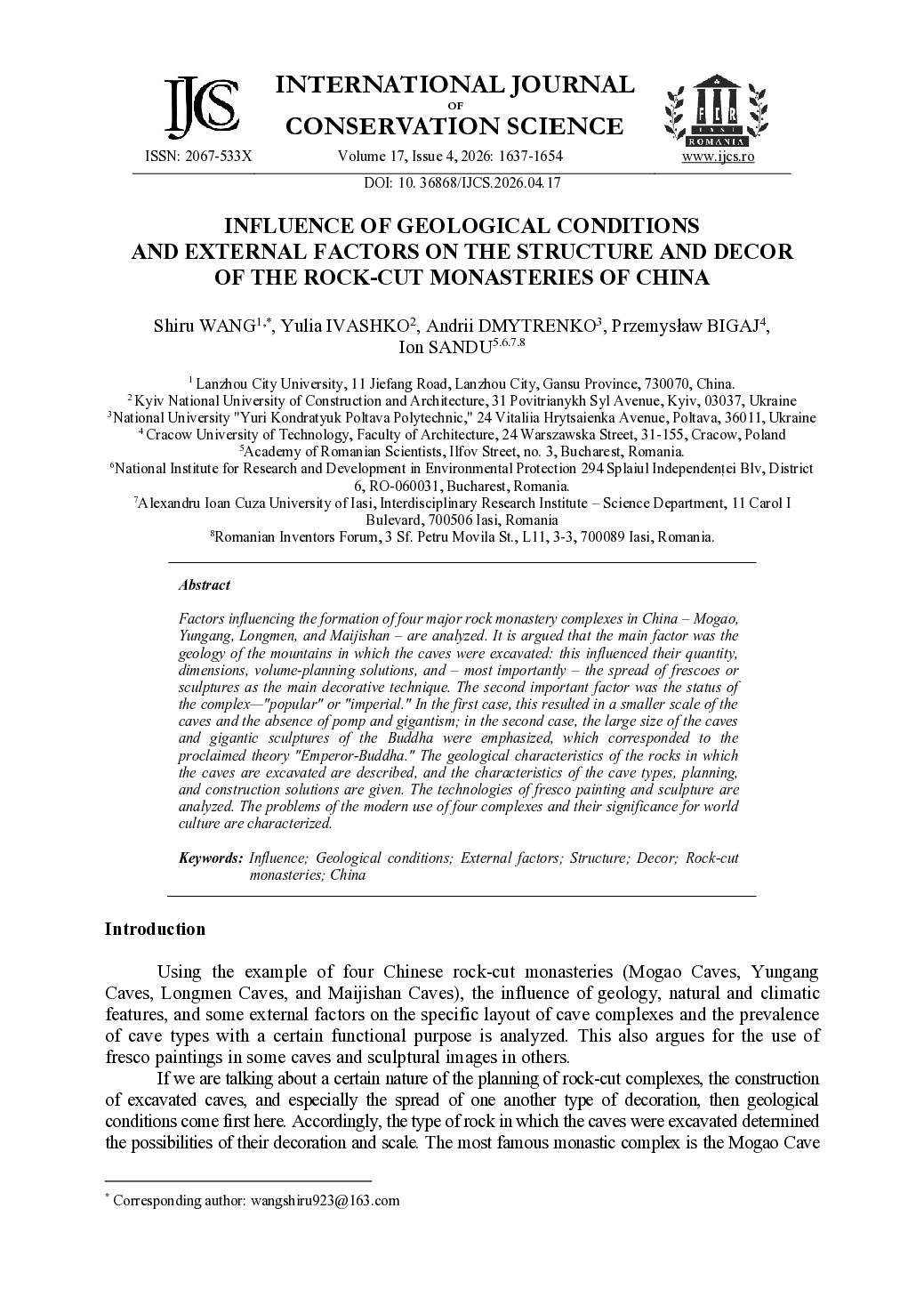
Influence of Geological Conditions and External Factors on the Structure and Decor of the Rock-Cut Monasteries of China
Українська
Вплив геологічних умов і зовнішніх чинників на структуру та оздоблення скельних монастирів Китаю
Автор
Українська
Українська
Українська
Українська
Українська
Англійська
Англійська
Англійська
Англійська
Англійська
Опис
Англійська
Factors influencing the formation of four major rock monastery complexes in China – Mogao, Yungang, Longmen, and Maijishan – are analyzed. It is argued that the main factor was the geology of the mountains in which the caves were excavated: this influenced their quantity, dimensions, volume-planning solutions, and – most importantly – the spread of frescoes or sculptures as the main decorative technique.
Англійська
У статті проаналізовано чинники, що вплинули на формування чотирьох великих скельних монастирських комплексів у Китаї — Моґао, Юньґан, Лунмень і Майцзішань. Стверджується, що головним фактором були геологічні особливості гірських порід, у яких вирубували печери: це визначило їхню кількість, розміри, об’ємно-планувальні рішення, а також — що найважливіше — поширення фресок або скульптур як основного засобу оздоблення.
Анотація
Англійська
Factors influencing the formation of four major rock monastery complexes in China – Mogao, Yungang, Longmen, and Maijishan – are analyzed. It is argued that the main factor was the geology of the mountains in which the caves were excavated: this influenced their quantity, dimensions, volume-planning solutions, and – most importantly – the spread of frescoes or sculptures as the main decorative technique. The second important factor was the status of the complex—"popular" or "imperial." In the first case, this resulted in a smaller scale of the caves and the absence of pomp and gigantism; in the second case, the large size of the caves and gigantic sculptures of the Buddha were emphasized, which corresponded to the proclaimed theory "Emperor-Buddha." The geological characteristics of the rocks in which the caves are excavated are described, and the characteristics of the cave types, planning, and construction solutions are given. The technologies of fresco painting and sculpture are analyzed. The problems of the modern use of four complexes and their significance for world culture are characterized.
Мова
Дата випуску
Ключові слова
Англійська
Англійська
Англійська
Англійська
Англійська
Українська
Українська
Українська
Українська
Українська
Видавець
Бібліографічний опис
Influence of Geological Conditions and External Factors on the Structure and Decor of the Rock-Cut Monasteries of China / S. Wang, Y. Ivashko, A. Dmytrenko, P. Bigaj, I. Sandu // International Journal of Conservation Science. – 2026. – Vol. 17, Iss. 4. – P. 1637–1654. – DOI: 10. 36868/IJCS.2026.04.17
issn
2067-8223
doi
DOI: 10. 36868/IJCS.2026.04.17
Медіафайли
Інформація про метадані
Створено
2026-11-17 12:28
Остання зміна
2026-11-17 12:28
Дата видачі (DC)
2026
ID елемента
#83089
Клас ресурсів
Стаття
Шаблон ресурсу
Наукова стаття