
Стаття
Наукова стаття
Економіко-математичне моделювання економічної динаміки у системі моніторингу та прогнозування соціально-економічних процесів
ID елемента: 77057
1 Медіафайлів
2026/05/07
Цитування
eNUPPIR (). Економіко-математичне моделювання економічної динаміки у системі моніторингу та прогнозування соціально-економічних процесів. https://reposit.nupp.edu.ua/item/77057
eNUPPIR. "Економіко-математичне моделювання економічної динаміки у системі моніторингу та прогнозування соціально-економічних процесів." Web. . <https://reposit.nupp.edu.ua/item/77057>.
eNUPPIR. "Економіко-математичне моделювання економічної динаміки у системі моніторингу та прогнозування соціально-економічних процесів." Accessed . https://reposit.nupp.edu.ua/item/77057.
Скопійовано в буфер обміну
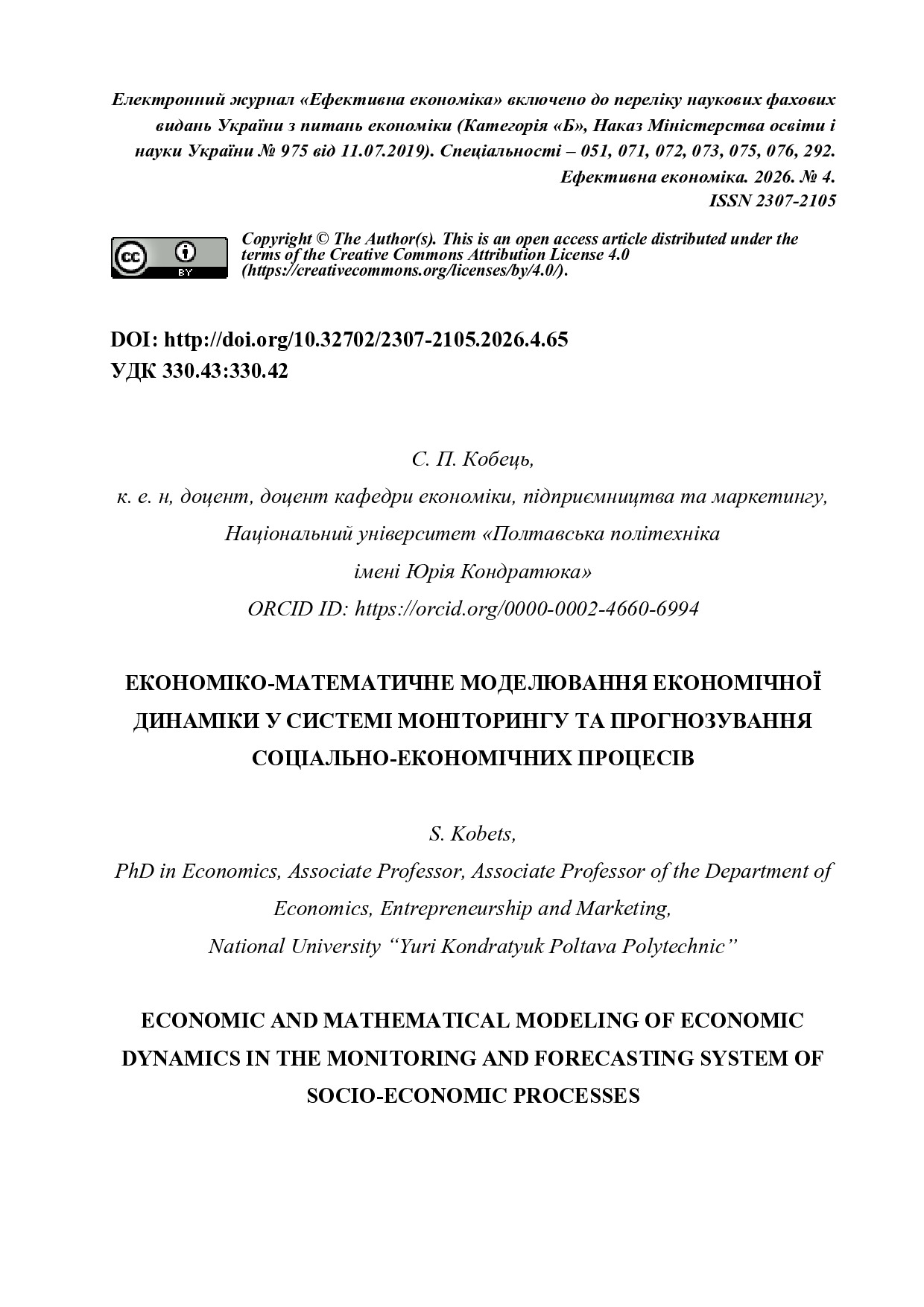
Стаття: Кобець С.П. Економіко-математичне моделювання економічної динаміки у системі моніторингу та прогнозування соціально-економічних процесів.
Властивості
Тип
Українська
Англійська
Назва
Українська
Економіко-математичне моделювання економічної динаміки у системі моніторингу та прогнозування соціально-економічних процесів
Англійська
Economic and mathematical modeling of economic dynamics in the monitoring and forecasting system of socio-economic processes
Автор
Українська
Англійська
Опис
Українська
Обґрунтовано роль моніторингу економічної динаміки як інструменту отримання верифікованої інформації для управлінських рішень;
Розроблено авторський методичний підхід до інтеграції економіко-математичних моделей у систему моніторингу (5-етапний циклічний алгоритм: збір даних → верифікація → моделювання → аналіз відхилень → генерація управлінських сигналів);
Побудовано регресійну модель залежності індексу промислової продукції від капітальних інвестицій, експорту товарів та індексу споживчих цін (R² = 0,873; F = 13,735; p = 0,004)
Розроблено авторський методичний підхід до інтеграції економіко-математичних моделей у систему моніторингу (5-етапний циклічний алгоритм: збір даних → верифікація → моделювання → аналіз відхилень → генерація управлінських сигналів);
Побудовано регресійну модель залежності індексу промислової продукції від капітальних інвестицій, експорту товарів та індексу споживчих цін (R² = 0,873; F = 13,735; p = 0,004)
Англійська
The role of economic dynamics monitoring as a tool for obtaining verified information to support managerial decision-making has been substantiated.
An original methodological approach has been developed for integrating economic-mathematical models into the monitoring system, structured as a 5-stage cyclic algorithm:
Data collection → Verification → Modeling → Deviation analysis → Generation of managerial signals.
A regression model has been constructed to assess the dependence of the Industrial Production Index on capital investments, goods exports, and the Consumer Price Index, demonstrating
An original methodological approach has been developed for integrating economic-mathematical models into the monitoring system, structured as a 5-stage cyclic algorithm:
Data collection → Verification → Modeling → Deviation analysis → Generation of managerial signals.
A regression model has been constructed to assess the dependence of the Industrial Production Index on capital investments, goods exports, and the Consumer Price Index, demonstrating
Анотація
Українська
У статті досліджено теоретичні та методичні засади застосування економіко-математичного моделювання у системі моніторингу та прогнозування соціально-економічних процесів. Визначено роль моніторингу економічної динаміки як інструменту отримання актуальної інформації про стан і тенденції розвитку економічних систем в умовах невизначеності. Обґрунтовано необхідність використання економіко-математичних моделей для глибокого аналізу та точного прогнозування соціально-економічних показників, що дозволяє мінімізувати ризики прийняття управлінських рішень. Розглянуто основні підходи до побудови моделей економічної динаміки, зокрема регресійні та економетричні моделі, що дозволяють оцінювати взаємозв'язки між економічними показниками та прогнозувати їх майбутні значення з урахуванням стохастичної складової. Запропоновано авторський методичний підхід до інтеграції економіко-математичного моделювання у систему моніторингу соціально-економічних процесів, який передбачає циклічне оновлення даних та верифікацію прогнозів. Емпіричну базу дослідження становлять офіційні статистичні дані Державної служби статистики України за період 2015–2024 рр. На основі багатофакторної регресійної моделі визначено вплив капітальних інвестицій, експорту товарів та індексу споживчих цін на індекс промислової продукції. Коефіцієнт детермінації R² = 0,873 свідчить про високу пояснювальну здатність моделі. Визначено можливості використання результатів моделювання для підтримки управлінських рішень та підвищення ефективності стратегічного планування розвитку соціально-економічних систем на макро-та мікрорівнях. Отримані результати можуть бути використані органами державного управління, підприємствами та аналітичними центрами при розробленні програм соціально-економічного розвитку та прогнозуванні економічної динаміки в умовах трансформаційних змін.
Англійська
This article examines the theoretical and methodological foundations for applying economic-mathematical modeling within the system of monitoring and forecasting socio-economic processes. The role of economic dynamics monitoring is defined as a tool for obtaining timely, reliable information on the state and development trends of economic systems under conditions of uncertainty.
The necessity of employing economic-mathematical models for in-depth analysis and accurate forecasting of socio-economic indicators has been substantiated, enabling the minimization of risks associated with managerial decision-making. Key approaches to constructing models of economic dynamics are reviewed, particularly regression and econometric models, which allow for assessing interrelationships among economic indicators and forecasting their future values while accounting for stochastic components.
An original methodological approach is proposed for integrating economic-mathematical modeling into the monitoring system of socio-economic processes. This approach incorporates a cyclic algorithm featuring iterative data updating and forecast verification.
The empirical basis of the study comprises official statistical data from the State Statistics Service of Ukraine for the period 2015–2024. Using a multiple regression model, the impact of capital investments, goods exports, and the Consumer Price Index (CPI) on the Industrial Production Index (IPI) has been quantified. The coefficient of determination (R² = 0.873) confirms the model's high explanatory power.
The study identifies opportunities for applying modeling results to support managerial decisions and enhance the effectiveness of strategic planning for socio-economic systems at both macro- and micro-levels. The findings may be utilized by public authorities, enterprises, and analytical centers in developing socio-economic development programs and forecasting economic dynamics amid transformational changes.
The necessity of employing economic-mathematical models for in-depth analysis and accurate forecasting of socio-economic indicators has been substantiated, enabling the minimization of risks associated with managerial decision-making. Key approaches to constructing models of economic dynamics are reviewed, particularly regression and econometric models, which allow for assessing interrelationships among economic indicators and forecasting their future values while accounting for stochastic components.
An original methodological approach is proposed for integrating economic-mathematical modeling into the monitoring system of socio-economic processes. This approach incorporates a cyclic algorithm featuring iterative data updating and forecast verification.
The empirical basis of the study comprises official statistical data from the State Statistics Service of Ukraine for the period 2015–2024. Using a multiple regression model, the impact of capital investments, goods exports, and the Consumer Price Index (CPI) on the Industrial Production Index (IPI) has been quantified. The coefficient of determination (R² = 0.873) confirms the model's high explanatory power.
The study identifies opportunities for applying modeling results to support managerial decisions and enhance the effectiveness of strategic planning for socio-economic systems at both macro- and micro-levels. The findings may be utilized by public authorities, enterprises, and analytical centers in developing socio-economic development programs and forecasting economic dynamics amid transformational changes.
Мова
Дата випуску
Ключові слова
Українська
Українська
Українська
Українська
Українська
Українська
Українська
Англійська
Англійська
Англійська
Англійська
Англійська
Англійська
Англійська
Видавець
Бібліографічний опис
Кобець С.П. Економіко-математичне моделювання економічної динаміки у системі моніторингу та прогнозування соціально-економічних процесів // Ефективна економіка. – 2026. – № 4.
issn
2307-2105
doi
https://doi.org/10.32702/2307-2105.2026.4.65
УДК
330.43:330.42
Інформація про метадані
Створено
2026-5-7 06:22
Остання зміна
2026-5-27 10:30
(Оновлено 20 днів після створення)
Дата видачі (DC)
2026-04-23
ID елемента
#77057
Клас ресурсів
Стаття
Шаблон ресурсу
Наукова стаття